









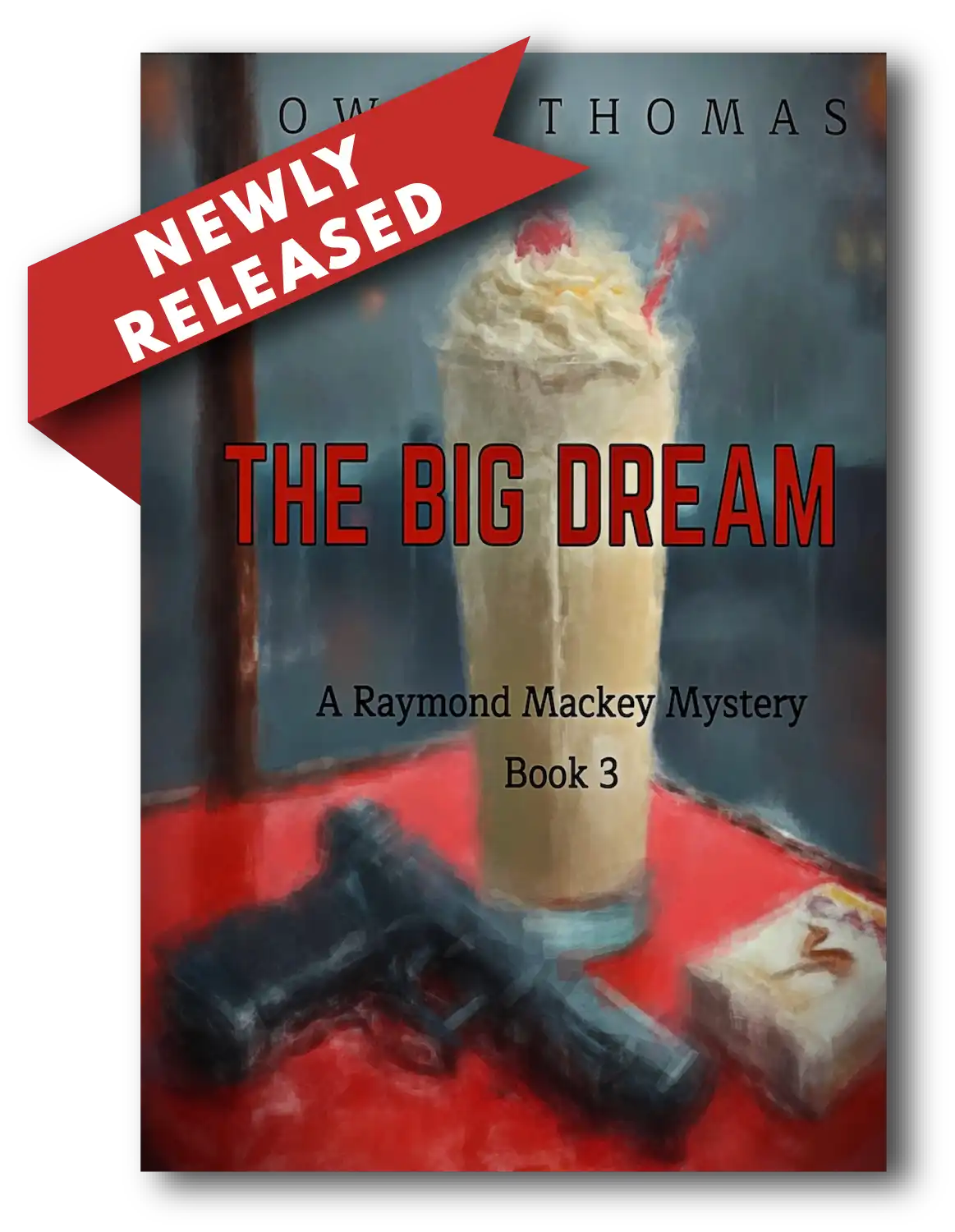
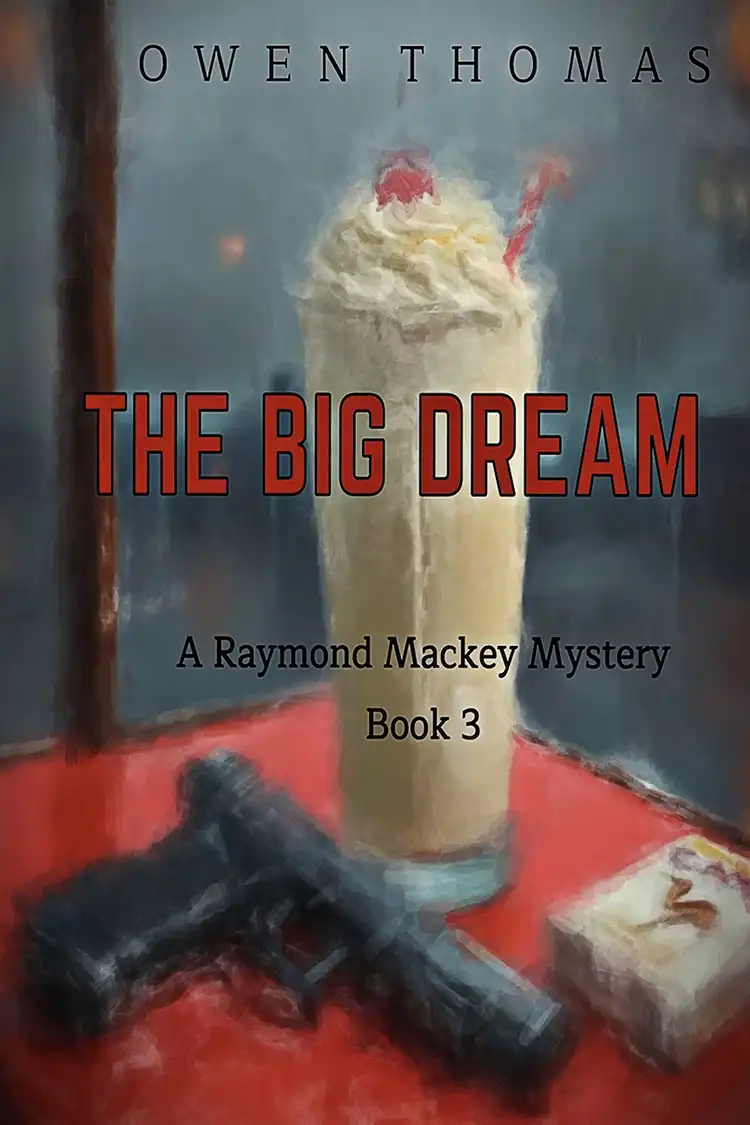
THE BIG DREAM
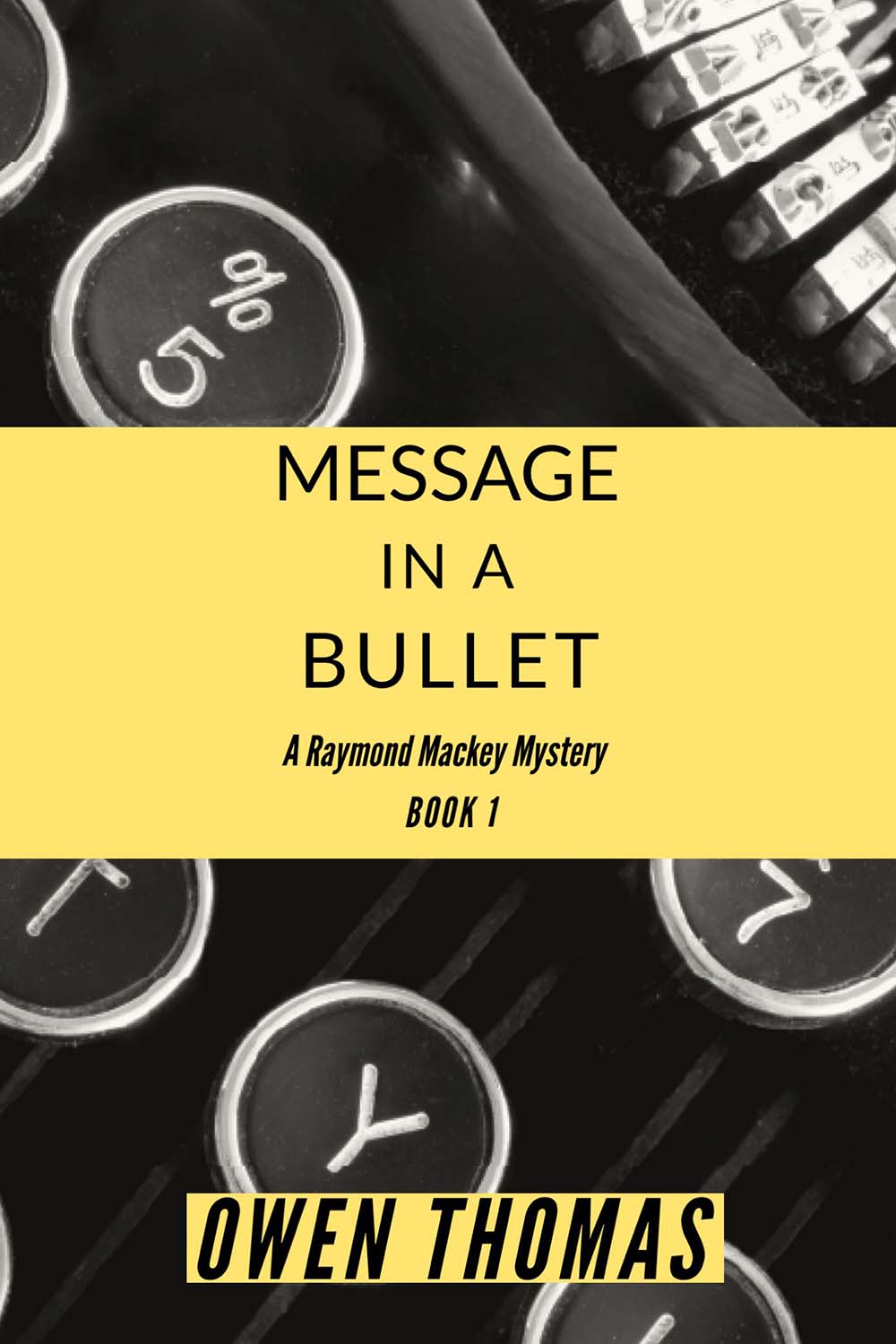
From multiple award-winning, best-selling author Owen Thomas, finally, The Big Dream. Like Message in a Bullet and The Russian Doll, this ultimate book in the gripping Raymond Mackey Mystery Trilogy inches you to the edge of your seat and keeps you there until the last captivating twist in a corkscrew plot. Welcome to spiral noir.
Marlo. Still dead. But more of a mystery than ever. A stack of business cards in an old file. A surprise lover. An old photo of Marlo keeping company with the Chicago underworld. It’s enough to make a hard-boiled detective wonder whether he ever really knew his wife at all. That realization alone might kill him.
Doesn’t matter. Bloody, beaten and broken; outgunned and maybe even out of his mind, Mack is coming for answers.
But if the answers are out there, they won’t be easy to find. Not in a city drowning in corruption. Not with so many enemies – police departments, the court system, the governor’s office, the mob, even the mayor of Chicago – looking to bring him down. Not with Big Man around every rain-soaked corner, relishing the deadly game of cat and mouse over drugs, murder, sex trafficking, money laundering, government influence peddling, and, most recently, the fraudulent manipulation of international financial markets.
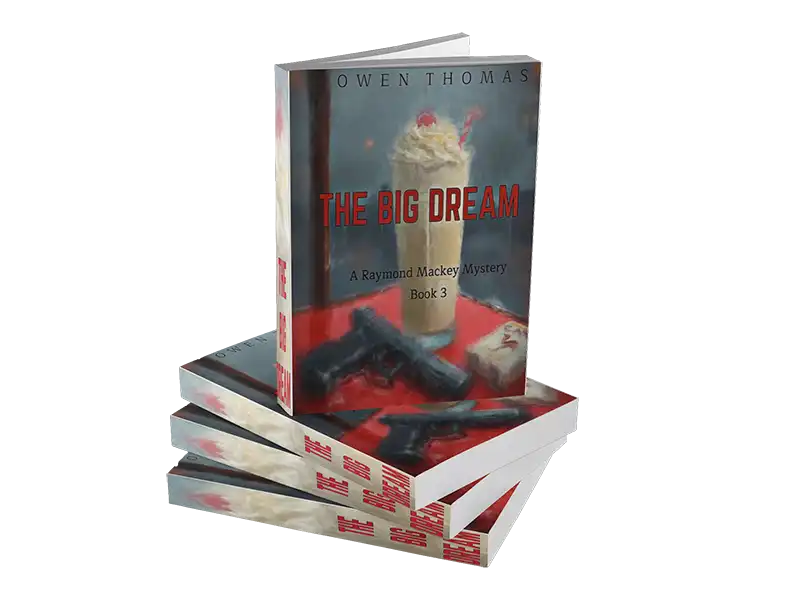
Paperback
ePub / Kindle
Gritty, atmospheric, and darkly witty, The Big Dream is masterful noir that explores the cost of loyalty, the weight of regret, and the lengths one man will go for answers.
NEWLY RELEASED!
“I’m fine with humanity,” says Mack. “It’s the people I can do without.”
He’s right about that. The people are the problem.
Mack’s new gig working for Internal Affairs hasn’t made him any new friends. The local cops still think Mack’s a mole for the mob.
The Illinois Attorney General wants to lock him up for his role in the Russian Doll fiasco.
Mack’s boss believes he’s a back-stabbing traitor after his job, even though a little surveillance shows the boss stepping out on his wife with the mistress of a dead man while the evidence that he had a hand in a double homicide is piling up with the bodies.
Mack’s missing informant turns up alive, but she has a formidable new friend and may be out for violent revenge.
And then there’s the foreign agent quietly flying under the FBI’s radar, in town to take Big Man down, murder him if necessary, and she’ll do anything to coerce Mack’s assistance.
So Mack can only count on himself. But that’s a problem too. The PTSD keeps him from sleeping and amps up the paranoia. The new spot on his lung keeps him from smoking but does nothing about the craving. The alcoholism is gaining traction. And the personality disorder is as strong as ever: he still follows himself around like a helium balloon tied to his own beltloop. Watching from above.
Commenting. Reminding him that he isn’t what he once was. Showing him the steepening downhill slide of his life.
Some might call it a disability. Others call it proof of crazy. Mack calls it a curse.
In the end, Marlo’s white Persian cat, Philomina, may be the only one to bear witness to Raymond Mackey’s triumph or tragedy. And to collect her drop of bourbon.
CLICK TO PURCHASE THE BIG DREAM
Paperback
ePub / Kindle
Perfect for fans of Michael Connelly, Raymond Chandler, Lee Child, and Robert Galbraith.
PRAISE FOR THE BIG DREAM
“[A] standout achievement in modern crime fiction.”
Book Viral Reviews
“The Big Dream confirms Owen Thomas as a crime writer operating at a rare level of control and ambition. This is not simply strong series fiction — it is exceptional contemporary noir.”
Book Viral Reviews
“Thomas keeps the narrative compelling as Mack races doggedly toward his hardboiled destiny. An immersive mystery caper with a memorably disturbed protagonist at its center.”
Kirkus Reviews
“[A] well-written detective thriller with a memorable main character. Owen Thomas’s stylish prose recalls Raymond Chandler in his ability to evoke a scene, and his lead’s cynical eye nods to some of the great hardboiled detectives.”
Indie Reader
“5 out of 5 Stars … a gritty noir crime saga that merges psychological suspense with hard-boiled detective fiction.”
Maincrest Media
“Thomas’ writing is marked by confidence, restraint, and an exceptional command of mood and tension; all signals of a writer with remarkable talent.”
Maincrest Media
“If you enjoy morally complex investigators, institutional corruption, and dark, atmospheric mysteries like The Poet by Michael Connelly and Bluebird, Bluebird by Attica Locke, you will feel right at home.”
Maincrest Media
“A thought-provoking, dark crime novel that combines an engaging mystery with profound emotional depth …”
Feathered Quill Book Reviews
“The Big Dream is an exceptional choice for enthusiasts of contemporary noir and literary thrillers.”
Feathered Quill Book Reviews
“The Big Dream is modern noir at its most compelling… A standout achievement in modern crime fiction.”– Book Viral Reviews
With The Big Dream, Owen Thomas does not simply continue the Raymond Mackey series — he deepens it, complicates it, and pushes it toward its most emotionally and morally fraught territory yet. If Message in a Bullet introduced Mackey’s world and The Russian Doll detonated it, this third instalment explores what remains when the smoke refuses to clear.
At the centre of the novel remains the shadow figure known as Big Man — a presence that has loomed over the series from the beginning. Here, that shadow sharpens. The threat is no longer abstract. It is intimate, manipulative, and strategic.
Thomas understands that long-running crime series succeed when antagonists evolve rather than simply reappear. Big Man is not reduced to a cartoon crime lord; instead, the novel reinforces his/her defining trait: control through invisibility. Influence is exerted through suggestion, leverage, documentation, silence. Mackey is not chasing a myth; he is navigating a network of unseen hands. That structural choice keeps the tension high even in scenes that rely more on conversation than confrontation.
One of the novel’s key strengths is its handling of Lieutenant Orland Twill. Twill is not merely a superior officer; he becomes a fulcrum of doubt. Questions of chain of command, loyalty, withheld information, and departmental politics run through the narrative. Twill’s position — at once supportive, evasive, and possibly compromised — reinforces the novel’s recurring concern: when institutions falter, where does allegiance lie? The ambiguity surrounding his knowledge and motivations is not incidental. It is foundational to the book’s moral tension.
Yet for all the political machinery turning in the background, The Big Dream remains deeply character-driven.
Suri’s return is one of the novel’s most compelling threads. In earlier books she was already layered — survivor, informant, addict, operator. Here, Thomas swings deliberately between brutality and tenderness in her portrayal. Suri occupies the space between victim and strategist with unnerving credibility. Her history of exploitation and resilience allows Thomas to move from scenes of stark violence to moments of unexpected emotional fragility without tonal whiplash. That balance is difficult to achieve; here it feels earned. In Suri, Thomas captures the emotional contradiction of the series itself — hardened surfaces concealing complicated loyalties.
Doris, too, returns as something more than background comfort. In a narrative so steeped in paranoia and institutional hostility, Doris represents grounding — but not naïveté. Her relationship with Mackey carries emotional weight precisely because it operates outside the corridors of power. As the story progresses, the fate of both Ray and Doris becomes a quiet but powerful undercurrent, culminating in closing chapters that leave readers with lingering uncertainty. Thomas resists the neat bow. Instead, he leaves space — space for consequence, space for continuation, space for loss.
Perhaps the most resonant element of the novel is the evolving significance of Marlo. The reveal surrounding her reframes earlier grief and suspicion in ways that feel both shocking and retrospectively inevitable. Rather than functioning as a simple emotional backstory, Marlo’s presence becomes structurally relevant to Mackey’s current entanglements. The emotional impact of this revelation is considerable, not because it is melodramatic, but because it forces a re-evaluation of what Mackey thought he understood about his own past.
Stylistically, Thomas remains faithful to a contemporary noir sensibility. The prose is sharp, unsentimental, and frequently laced with mordant humour. Mackey’s voice carries the weariness of a man who has been outmaneuvered more than once but refuses to accept the label of pawn. Importantly, Thomas avoids glamorizing Mackey’s deterioration. There is no romantic haze around his paranoia, exhaustion, or self-doubt. Instead, these traits heighten tension. The reader is constantly asked to assess whether Mackey is perceiving clearly or being manipulated — a dynamic that mirrors the series’ larger themes of misinformation and institutional distortion.
The novel’s pacing reflects its thematic ambition. Action sequences exist, and when violence arrives it is abrupt and consequential rather than cinematic spectacle. But much of the book’s propulsion comes from interviews, documents, surveillance, withheld emails, and strategic conversations. This procedural layering enhances credibility. Thomas understands that modern corruption is bureaucratic before it is bloody.
Crucially, The Big Dream expands the scale of the series without losing its emotional core. Big Man’s operations remain central, yet the conflict feels less like a battle between cop and criminal and more like a struggle over narrative control. Who writes the story of what happened? Who decides what counts as evidence? Who survives to tell it?
The closing chapters are particularly effective. Rather than delivering total resolution, Thomas leaves readers in a space of uneasy anticipation. What will become of Ray? Is there a future with Doris? Is this survival or temporary reprieve? The ambiguity feels deliberate rather than evasive. It honours the series’ refusal to simplify power dynamics into tidy outcomes.
By this third book, the Raymond Mackey series has evolved into something more ambitious than a standard procedural. It is crime fiction concerned not only with wrongdoing but with perception, leverage, loyalty, and the cost of pulling at systems that resist exposure. Here The Big Dream stands as the series’ most emotionally expansive and politically intricate entry. Readers invested in the arc of Raymond Mackey will find their expectations challenged and deepened. Newcomers will encounter a noir landscape where violence and tenderness coexist, institutions wobble, and the truth is never simply waiting to be uncovered — it must be wrestled into view.
In the end, The Big Dream confirms Owen Thomas as a crime writer operating at a rare level of control and ambition. This is not simply strong series fiction — it is exceptional contemporary noir. The psychological layering recalls the moral complexity of Dennis Lehane, the institutional unease of Michael Connelly at his most politically charged, and the existential weight of James Lee Burke’s later work, yet Thomas’s voice remains distinctly his own. Few crime writers sustain this level of narrative intelligence while deepening character with each instalment.
The Big Dream is not just the strongest Raymond Mackey novel to date — it is a standout achievement in modern crime fiction and an unreservedly recommended Golden Quill read!
CLICK TO PURCHASE THE BIG DREAM
Paperback
ePub / Kindle